Into the Light – Interview with Bettina Pelz
Bettina Pelz is an internationally active curator based in Bremen. Her curatorial research focuses on light and light-based media in contemporary art. Her curatorial practice is dedicated to art-in-context projects. Since 2004, she has had a teaching assignment at the University of Arts in Bremen. Her EXHIBIT class is a framework to explore exhibition practices through the lens of artists.
How would you describe your curatorial practice in your own words?
My curatorial practice is about creating situations in which artistic perspectives render visible. I understand curating as a process as weaving a network of relationships among artistic practices, situations, and audiences.
What does “art-in-context” mean to you in practical terms?
Context can be time or place, natural or cultural settings, historical frames, or political climate … defining the situation and understanding the conditions ignite my curatorial processing.
How do you decide whether a project should take place in public space, a cultural institution, or a hybrid setting?
The placement is part of the dynamic matrix from which the exhibition emerges. In the curatorial process, the reflection shifts back and forth between what is conditoned by the site, what by the artwork, what by the curatorial theme, and what is conditioned by the audience.
Your work often connects artistic research, technical innovation, and media archaeology. How do those elements shape a project?
Artistic research and development do not emerge from a vacuum; they are embedded in theoretical or conceptual frameworks, in experimentation with materials and technologies, and in engagement with sites and situations. I include the from-where and the where-to, the not-yet and what-if aspects as part of a polyperspective approach that shapes the exhibition featuring the artwork and the context alike.
What role does light play in your curatorial thinking beyond being a visual medium?
Light is a relational medium; it behaves as a particle or a wave, depending on the viewer’s perspective. It defines time and space, shapes our experience of color, and influences our experiences. It becomes visible only when it interacts with other materials or media. It mediates situations and creates contexts. It became my research lens of how to reflect on a situation.
How do you balance artistic ambition with logistical, technical, and social realities?
They are part of the material, the texture. I try to treat these realities as part of the material of the project and the curatorial synchronizing means finding a form in which artistic ambition remains intact while the work is technically feasible, socially responsible, and respectful of its setting.
How do site, and audience influence the final form of your exhibitions?
That varies in each project, in the best case, the negotiation between the site, its audience, and the artwork is the source of something new.
What makes a curatorial project feel successful to you?
When all aspects fall into place, when conceptual clarity, artistic precision, entanglement with the situation grow into something new, unpredicted, revealing an inner logic.
What do you look for in an artist when building a curatorial project?
I value interest and curiosity, resonance and conversation, debate and new ways of seeing, negotiation and learning …
How do you adapt your curatorial method when working with artists from different generations or backgrounds?
Handling complexity is at the core of the curatorial attitude, diversity and difference are part of the feed.
How do you support artists in developing site-specific work without restricting their creative freedom?
Artistic freedom is just as essential to this collaboration as curatorial freedom; in creating the exhibition, these two independent spheres interact, giving rise to conflicts and compromises. It takes persistence to find solutions that benefit both sides.
How do you navigate the tension between artistic experimentation and public accessibility?
Research and development always requires mediation, whether in science, technology, or art. It is a matter of audience care and art mediation.
Why is it important to you to work with emerging artists?
It is a very good exercise – it comes with more uncertainty, more experimentation, less clarity about the qualities.
What do emerging artists bring to your projects that established artists may not?
May-be they are the update for the program …
How do you define “emerging” in your curatorial context?
Everyone whose opportunities are not yet supported by their reputation.
How do you create opportunities for younger artists in public-facing and international projects?
I work with a dedicated diversity grid in every curatorial project to reflect on the representation of gender, age, backgrounds o.a. in every project I try to create a different frameworks that respond to the these aspects. Working with emerging artists needs more time for discussion, and developement, more production support and test than working with experienced artists. Often the “young masters’ projects” are the first to be implemented.
Your biography shows a strong teaching and mentoring dimension. How does your teaching inform your curating?
Through my teaching practice, I am in contact with students and alumni/ae. I learn about their ideas and what they are aiming for. I can follow their experimentation, and their progress. I am constantly on the lookout for what can be applied in a professional context.
What do you hope younger curators learn from your way of working?
The joy of working with complex systems.
What future do you hope to help shape through your work with artists, students, and publics?
Providing learning environments for making the world a better place.
What are you most curious to explore next?
I am looking forward to also working with collections with long-term exhibition formats.
FEATURED IMAGE
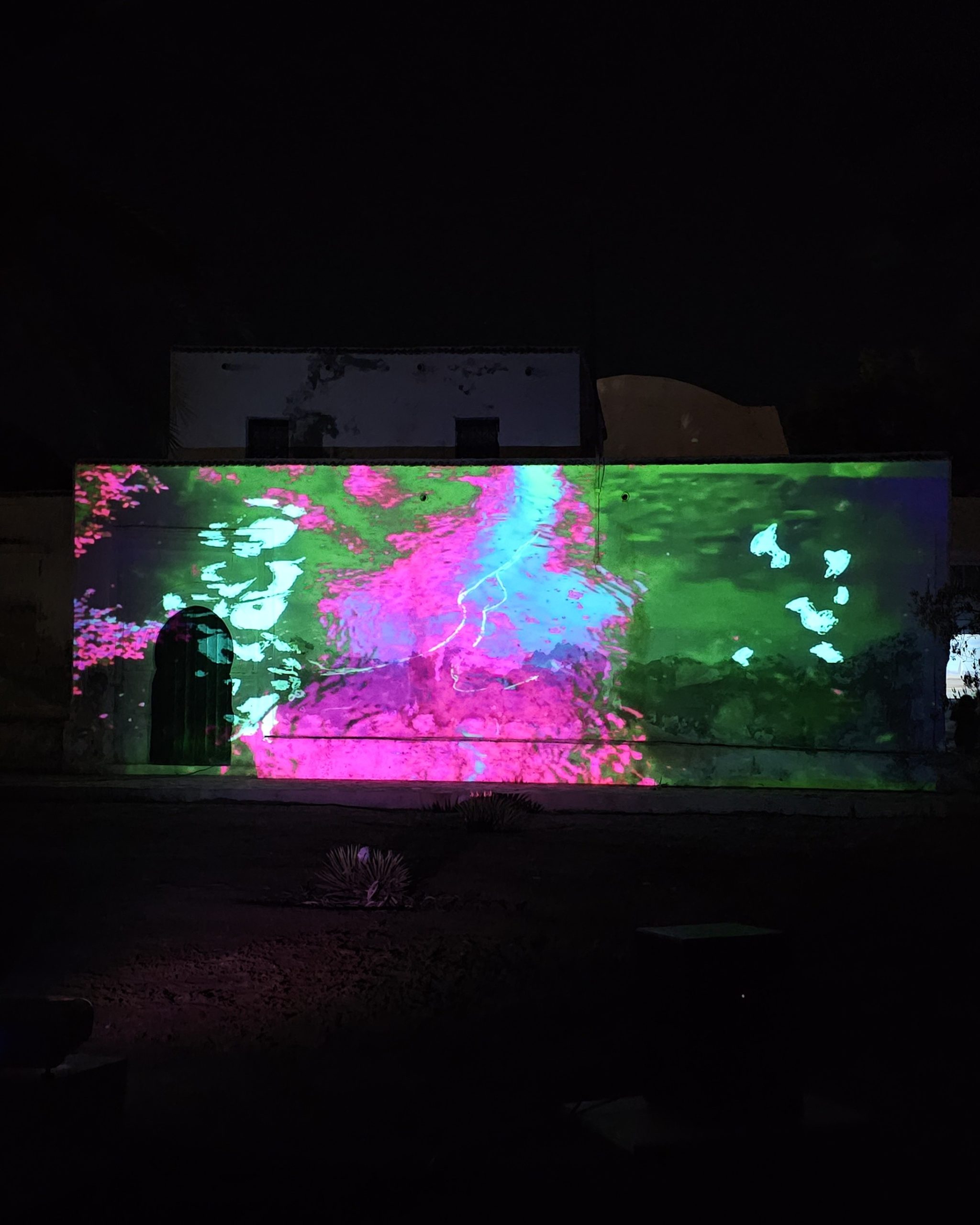
Anja Kreysing. SEE DJERBA Houmt Souk 2025.
PHOTO Kunstpelz
CREDIT
AUTHOR Mary Muse
PUBLISHED 29 MAY 26