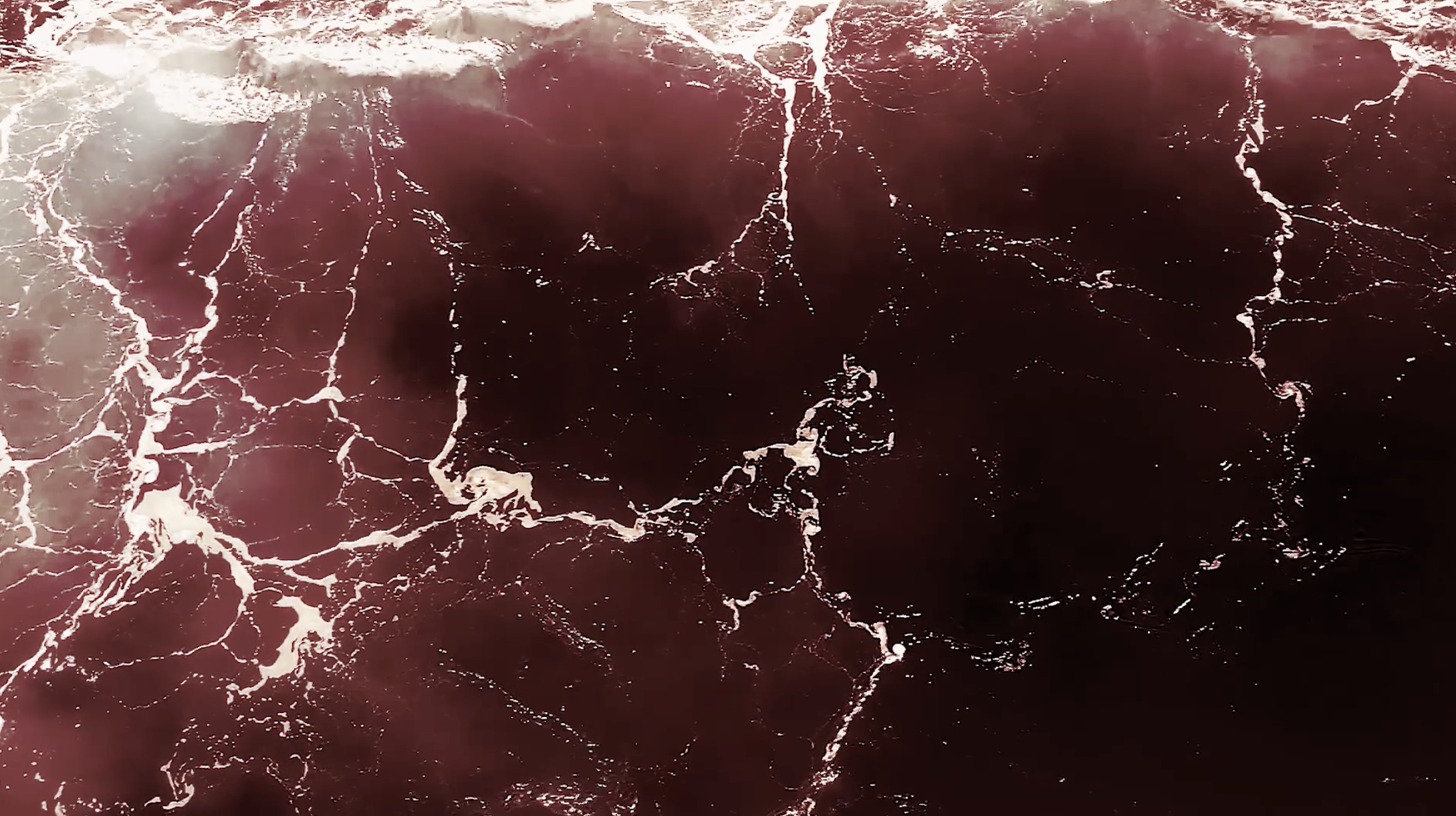
the longer you look – Mael Glass
Mael Glass works with painting, video and installation, observing what holds together and what doesn’t: in patterns, in structures, in the way power moves through bodies and space.
As a teenager, Mael was invited to the Philippines to live and collaborate with local artists in Baguio City — an experience that shaped a solo exhibition and led to further work being shown in a group show. The focus throughout was on creating space for exchange within the community itself.
That period left a lasting mark on Mael’s artistic identity. Having worked mostly with traditional materials before, the collaboration with Filipino artists opened up a freer, more liberated form of expression — an openness that still runs through the practice today.
A current video work turns to proximity, observation and power, watching men and animals move through urban space and examining how that space gets occupied. The line between observing and exposing is left deliberately unresolved — not something to be reached, but something to sit inside of.
You were already exhibiting in Asia when you were underage. Was that part of an apprenticeship or how did that happen?
It wasn’t an apprenticeship — I was invited to spend several months in Baguio City with part of the local artist community as a teenager. I showed work there, and left with something I couldn’t have found elsewhere: a way of thinking about practice that doesn’t have to justify itself to anyone. That stays with me.
The video work “Exposure” is quite intimate. What do you feel in those moments when you’re filming people? And where’s the line between exposure and observation?
Filming feels like a strange position to be in. You’re present but invisible, which creates a kind of intimacy that isn’t really yours to have. There’s something unsettling about that, and I think that tension is part of what the work is about. What I was observing were men in public spaces, in the city, and sometimes in more private moments, as well as animals within the same urban environment. Through editing I built an associative chain, pairing footage by what rhymed visually or behaviourally rather than by logic. That felt honest to how I actually experienced it. What fascinates and disturbs me equally is how much space men can allow themselves to take up: physically, sonically, socially. Whether that’s conscious or not is hard to say; a lot of it looks like learned behaviour, performance that mostly seems directed at other men. But in more private moments that performance gets smaller and something more unguarded comes through. I was interested in both ends of that. The line between exposure and observation is thin. I don’t think I fully resolved it, and I’m not sure I wanted to.
Do you feel that your work is perceived differently in other countries?
Honestly, every time I show work it’s different — regardless of where. It depends on the person standing in front of it, on the context, and on the work itself, which changes as I do. I’ve been making work for ten years now and what I make today is not what I made at 16. I think that shift in practice matters more to how work is received than geography does.
Do people find a way to engage with your work? Who are you trying to reach? Or is that not one of your intentions?
It shifts entirely depending on the work. With “it may hold the tension” people spent a long time with the water basin: the reflection keeps changing, so there’s always something new to find if you stay. A painting pulls a different kind of attention, more immediate. A video installation gets watched until someone finds the loop, or gives up before that. But I’m not sure “reaching people” is quite how I think about it. A lot of what I work with are things that make me uncomfortable; I use the work to explore that. So if someone reacts to it, even subtly, that means something to me. I’m more interested in whether the work creates a situation you can’t fully resolve than in whether it’s widely understood.
INTERVIEWER Waleria Sadkow
PUBLISHED 14 JUN 26
FEATURED IMAGE Mael Glass