A Suitcase and a Deadpan – Interview with Waleria Sadkow

Waleria Sadkow was born in Tashkent and has lived and worked across Dresden, Vienna, Kassel, Mexico and now Bremen. A path she describes less as restlessness and more as freedom. Graphic design, wood sculpting, industrial design, fine art: chapters that felt closed at the time, now quietly connecting into what she calls a grand almanac.
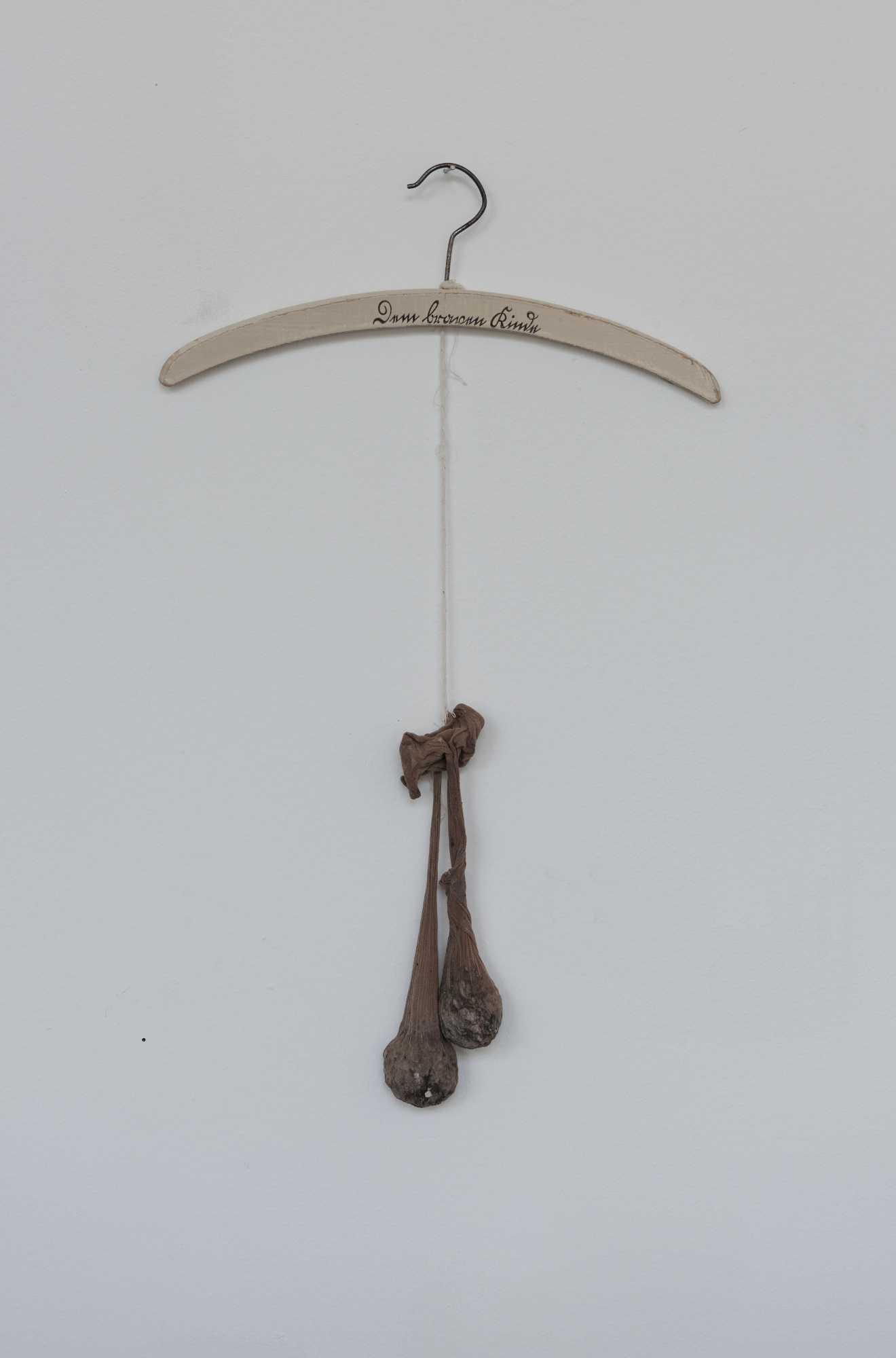
Her work has a deadpan quality; testicles on walls, banana peels, titles like “Klöten an der Wand” and “Bafögobdachlose” — that lands somewhere between absurdity and precision. She’s shown sculptures at minigolf courses and county offices and finds it amusing every time. What she wants from a viewer is a reaction — any reaction. She has no control over which one. She’s happy about that.
There’s a tension she keeps returning to: between the trashy materiality she’s drawn to and a quieter sculptural impulse that wants to carve delicate things. She hasn’t resolved it yet. For now, she works out of a suitcase. The most important things in it: openness and tape.
You were born in Tashkent and your CV moves through Dresden, Vienna, Kassel, Mexico, and now Bremen. Does place influence your work, or are you more internally driven?
I think that this lack of ties completely frees me up to explore different approaches and connect with different people. For me, there’s no such thing as “that’s not how you do it” – workplace safety! Through my work, I want to reach people who are going through similar experiences and make them feel seen in unexpected moments. I’ve fully embraced this openness and it’s reflected in my work. Life’s challenges motivates me to experiment and rebel.
Your path reads like a curriculum of crafts — graphic design, wood sculpting apprenticeship, industrial design, fine art. Do these feel like chapters, or are they all still active at the same time?
Great question! After each phase I also felt I had closed that chapter and that my studies were the next one. But now I realise that this collected knowledge was just waiting for a moment to connect with the other chapters. I’m slowly sensing how these fields of knowledge are being sorted into a grand almanac.
Your work titles — “Klöten an der Wand”, “Bafögobdachlose”, “Mit 5PS bewegt” — have a certain deadpan to them. How do titles come into your process — do they arrive with the piece or after?
Fragments usually pop into my head during the creative process. Even while researching I quickly link information together and before I even know it I created a title.
You’ve shown work at a minigolf course and at a county office. How much does the context — where something is shown — shape what you make?
I usually don’t think about where the works will be exhibited. For my part I always find it extremely amusing to see my odd works (testicles, banana peels) in places that are usually very serious. I appreciate the courage of the exhibitors. The situation is completely different at a symposia which set specific guidelines. therefore you actually create a sculpture with specific guidelines and given materials (outdoor or indoor, wood, log length, and so on). In the specific case of the mini-golf course the artwork must be an part of the hole.
Is there something you want your work to do to the people who see it? A state or a feeling?
Yes, it’s important to me that my work creates a reaction – a sense of alienation, superiority, joy. Even a dismissive attitude towards my work is lovely to see. That actually says more about the viewer. I’m just shaping my knowledge and feelings into objects. I definitely think my works and titles bring something out. I have no control over what that is – and I’m actually happy about that.
What’s something you keep returning to that you haven’t quite solved yet?
I love my trashy work pieces because they’re a d*mn funny distorted mirror of society. But there’s this sculptural side of me that wants to carve delicate objects. Somehow I keep losing touch with that. I see trash and other weird materials and think that the work comes across sooo much better through this materiality and stimulates the viewer. Maybe I feel like people are tired of wood but maybe I’m just too close to the material and can’t accept it for now.
You mentioned working out of a suitcase is kind of your specialty — what’s most important to have in it?
Openness and tape! I enjoy these absurd moments that you can’t foresee. I don’t have a chance to get lost in my thoughts and get straight to the point. The works are simply honest and offer the viewer a point of entry that doesn’t require prior general knowledge.
FEATURED IMAGE
Waleria Sadkow. Klöten an der Wand (2025).
PHOTO: Greta Nicklaus
CREDITS
INTERVIEWER Mael Glass
PUBLISHED on 14 JUN 2026