Circulation Of Images – Interview with Ruomeng
Ruomeng works with photography, space, and image-based installations. Her practice focuses on the production and transformation of images, particularly in relation to political structures and everyday life. Her work often involves collecting, reusing, and reinterpreting existing materials, allowing distortions and entropy to become part of the process. Through this approach, she explores the tension between visibility and absence, control and loss.
Who are you?
Ruomeng, I see myself as an artist working with images, rather than belonging to a single medium.
What is your artistic practice?
Currently, I work with painting, collage, and recomposing images.
How do you work?
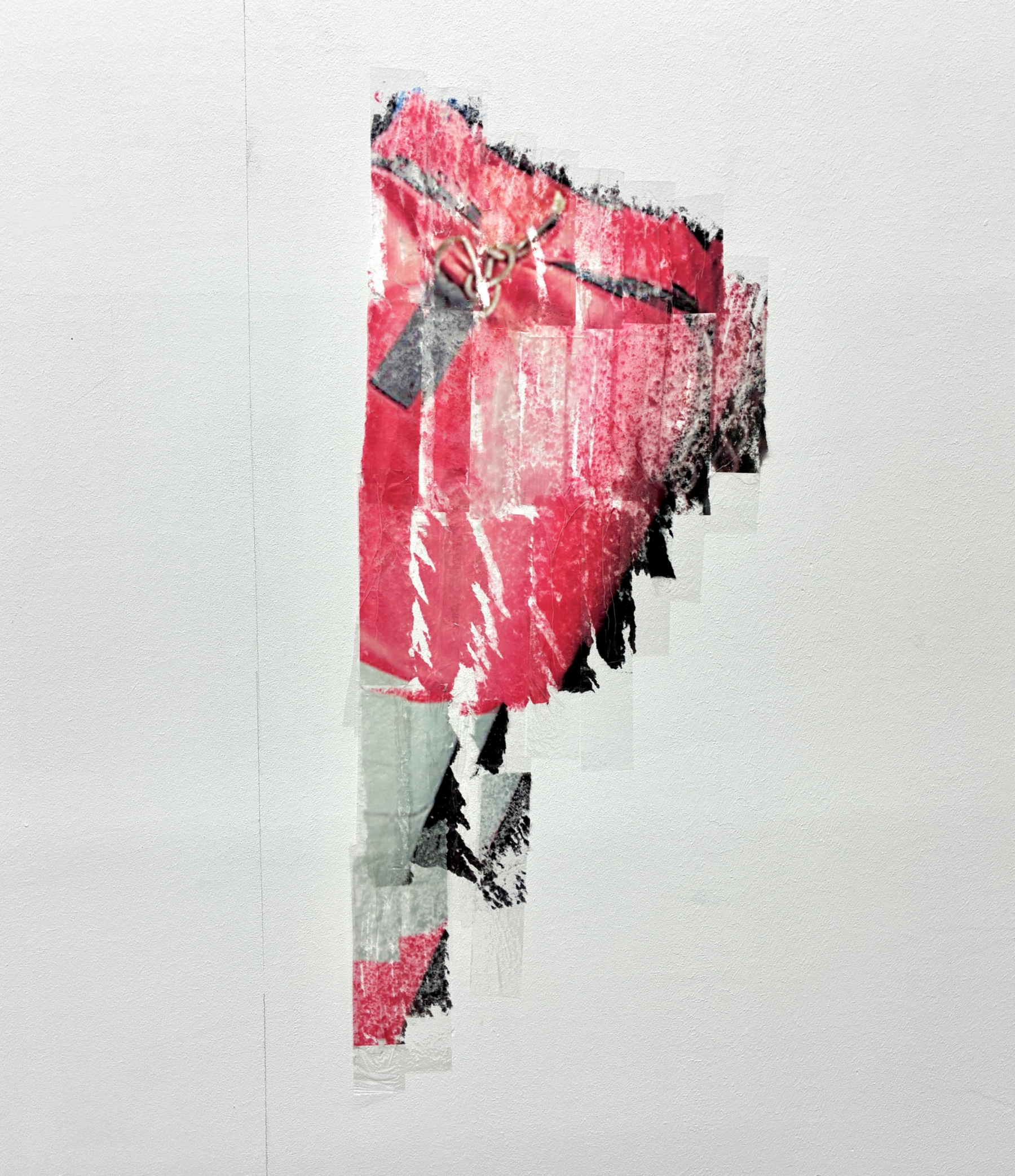
I work with photographs and screenshots that I collect from everyday life and the internet. I then intervene in them by painting, collaging, or using tape to destroy, transfer, and reconstruct the images.
Why are you interested in this way?
I grew up with the emergence of the internet, and saw how image quality from low to high, and then because of some political and legal factors , back to unclear again. I am interested in this process of collapse and distortion. Image quality as well as invisibility is closely related to questions of power.
Where do you present your works?
My works are often presented in a white cube, Sometimes in unconventional exhibition spaces, such as gyms or butcher shops, they engage with topics such as politics.
When are you entering a working state?
I don’t easily enter a working state, but I continuously think and collect.
Sometimes it takes me a long time, even several years to understand what is happening around me, and only then I respond through my work. At other times, the response is immediate, and a work can be finished within a few days. Both rhythms exist in my practice.
Can you describe your artform?
Image-based practice
Tell me about your artistic research
My research focuses on the circulation of images, especially how images degrade, distort, and lose clarity.
I’m interested in how this process relates to power, visibility, and control.
What material are you using?
Photographs, paint, prints, found materials
Explain me your aesthetic vocabulary
Distortion, fragmentation, duplication, low resolution
Do you have referential projects?
Artists such as Hito Steyerl, Jon Rafman
AURTHOR Pelle Schemmel
PUBLISHED 2 JUN 26
FEATURED IMAGE Ruomeng Huang